




































































Early Life and Coaching Roots
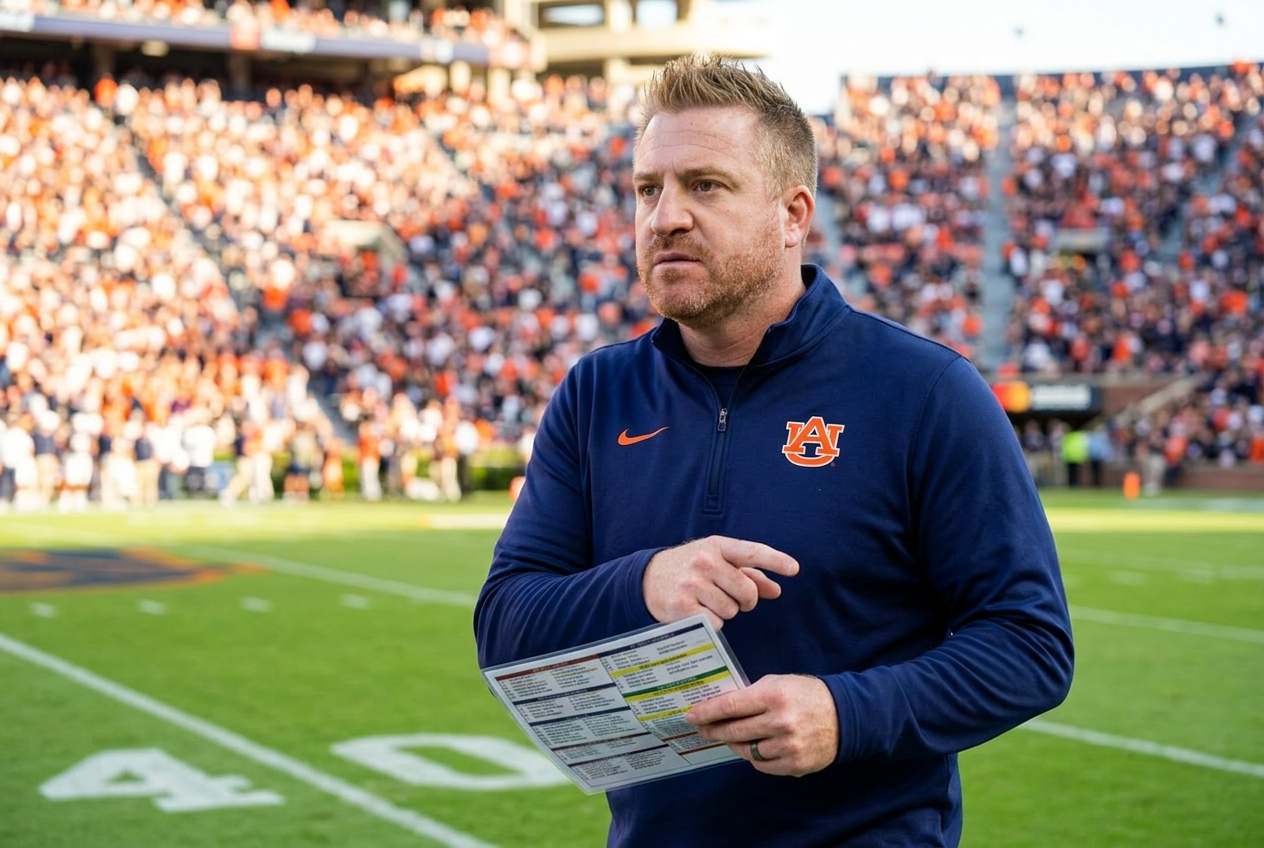
If somehow you haven't heard, Alex Golesh was born in Moscow. Yeah, Moscow, Russia. And I have a feeling if you tune into any Auburn Football in 2026, the broadcast will undoubtedly repeat that fact again and again.
Okay fun fact noted, let's talk ball. I was fairly surprised to learn that one of the most successful offensive minds in college football actually got his start on the other side of the ball. Yep, Alex Golesh is a defensive guy at his core. "At his core" might be a bit of a reach, but his first stop was Ohio State as a defensive student assistant, then on to Northern Illinois and Oklahoma State as a defensive GA. So, truly his first few jobs in the industry were on defense.
Things changed when Oklahoma State defensive coordinator Tim Beckman landed the head job at Toledo. Beckman liked Golesh, and he trusted him. Beckman trusted Golesh’s work ethic so much that he brought him along and plugged him into the one spot on the staff that still needed to be filled: running backs coach. Just like that, Golesh shifted from defense to offense, and the road opened before him.
Mentors and Influences
Although Golesh’s offense today looks very much like the Art Briles family of wide-split, tempo-heavy attacks, he didn’t grow up in that tree. As I mentioned earlier, his first offensive job was at Toledo, where he occupied a meeting room led by OC Matt Campbell, WR coach Scott Satterfield, and TEs coach Jason Candle. Matt Campbell is the newly hired head coach at Penn State, Jason Candle is the head coach at UConn after a successful stint at Toledo, and Scott Satterfield is the head coach at Cincinnati. Being around that elite group, even as youngsters, gave Golesh a depth of education in how modern offenses create space, win matchups, and control the game on their terms with a physical run game.
After Toledo, the most impactful offensive influence came when he crossed paths with Josh Heupel. The connection started through shared relationships, but it grew quickly once Heupel saw how Golesh recruited, organized, and taught. In 2020, Golesh arrived in Orlando as the co-offensive coordinator and tight ends coach, and this is where he was fully immersed in the Briles-descended spread that would define his future.
Heupel’s offense pushes the limits of width and tempo. The Veer and Shoot philosophy that Heupel employs takes core spread concepts to another level: extremely wide receiver splits and rapid tempo, all while giving the quarterback easy reads. Golesh has said repeatedly that Heupel's offensive advantage wasn’t just the pace, but the clarity for the quarterback. The system was built to be simple for players and miserable for defenses.
Golesh absorbed everything. How to teach receivers to run from extreme splits without losing timing, how to pair vertical run game structure with tempo, how to turn base plays into explosives just by speeding up the the operation. When Heupel took the Tennessee job, Golesh followed and learned how to scale the same system to the SEC and weaponize it with elite talent.
Those years with Heupel sharpened and molded Golesh's plan for his own offense, and they turned him into one of the best architects of the up-tempo, wide-split spread philosophy, commonly known as the Veer and Shoot. But the real proof of his coaching prowess showed up at South Florida. Before Golesh arrived, USF had won four games in three seasons, cycling through coaches and finding rock bottom at 1-11 in 2022. Golesh took that same program and delivered 7-6 in year one, another 7-6 with a bowl win in year two, and 9-3 with the number two total offense in the country in year three. That type of rebuild is unbelievably impressive, regardless of conference pedigree, and it's why he landed the Auburn job.
The Golesh Blueprint
This is the part where we get into the technical football weeds a little bit, but it’s my blog, so you know what you’re signing up for. To get a real feel for what Alex Golesh is bringing to Auburn, I went back and broke down two full USF games from 2025: the win over Florida and the matchup with Navy. And when I say “broke down,” I mean the whole thing: backfield sets, formations and tags, motions, run schemes, route concepts, personnel groupings, receiver splits, plus all the little stuff like FIB (formation into boundary), RPOs, and play-action tags.
It takes a LONG time. When we scouted an opponent for a game plan working for Kevin Steele, we would grind through six or seven games to build a complete report. That's pretty standard in the college football world, but I have a real job and can't spend 12 hours a day breaking down tape. Two games is enough! We have what we need.
Philosophy: Why the Offense Exists
Offensive football continues to evolve and reinvent itself. The latest significant innovation couples hurry-up tempo with entire-field spacing to dictate and control the defense. Golesh explains in a video on Coaches Insider:
"The key to the whole thing is we control the pace of play the whole game. We control the defense through our tempo."
Something else I found interesting is Golesh says this offense is unbelievably simple for the players, but for the coaches, it's extremely complex.
"For us, how we coach it, how we teach it, how we build a base and then build off that base, it's the most complicated system I've ever been a part of, and it gets more complicated when you talk situational football."
In football, every coach has to balance creativity and usability. The more flexible and nuanced a system is, the harder it is to teach and communicate everything to the players. For the players, simple is better, but that creates limitations on what coaches can do schematically. If what Golesh said is true, I'd be fascinated to learn how they develop an extremely complex system that allows for nuance and options while also being able to teach it to the players very simply - sounds like a dream.
Tempo is Everything
Tempo is the cornerstone of the entire operation. It's imperative for Golesh's offenses to go fast and be up-tempo. It's not optional.
"Tempo is our identity, not a tool. It's how we practice, it's how we workout in the weight room. Everything we do has a sense of urgency and a tempo."
In this offense, tempo has three main benefits:
It creates tired and unsound defense.
It steals yards and explosive plays.
The more times you snap the ball, the more chances you have to score.
After watching several interviews, some teach tape, and doing two full game breakdowns, I can confirm what he says is true. Save a few random spots, his teams ONLY operate in tempo. The video below is a great example of how Golesh's tempo works. USF gets a completion on 2nd & 6 to get a first down, and they immediately roll with tempo to exploit the defense. Watch below.
Here's a screenshot at 0:17 to point out a few specifics following the first down catch:
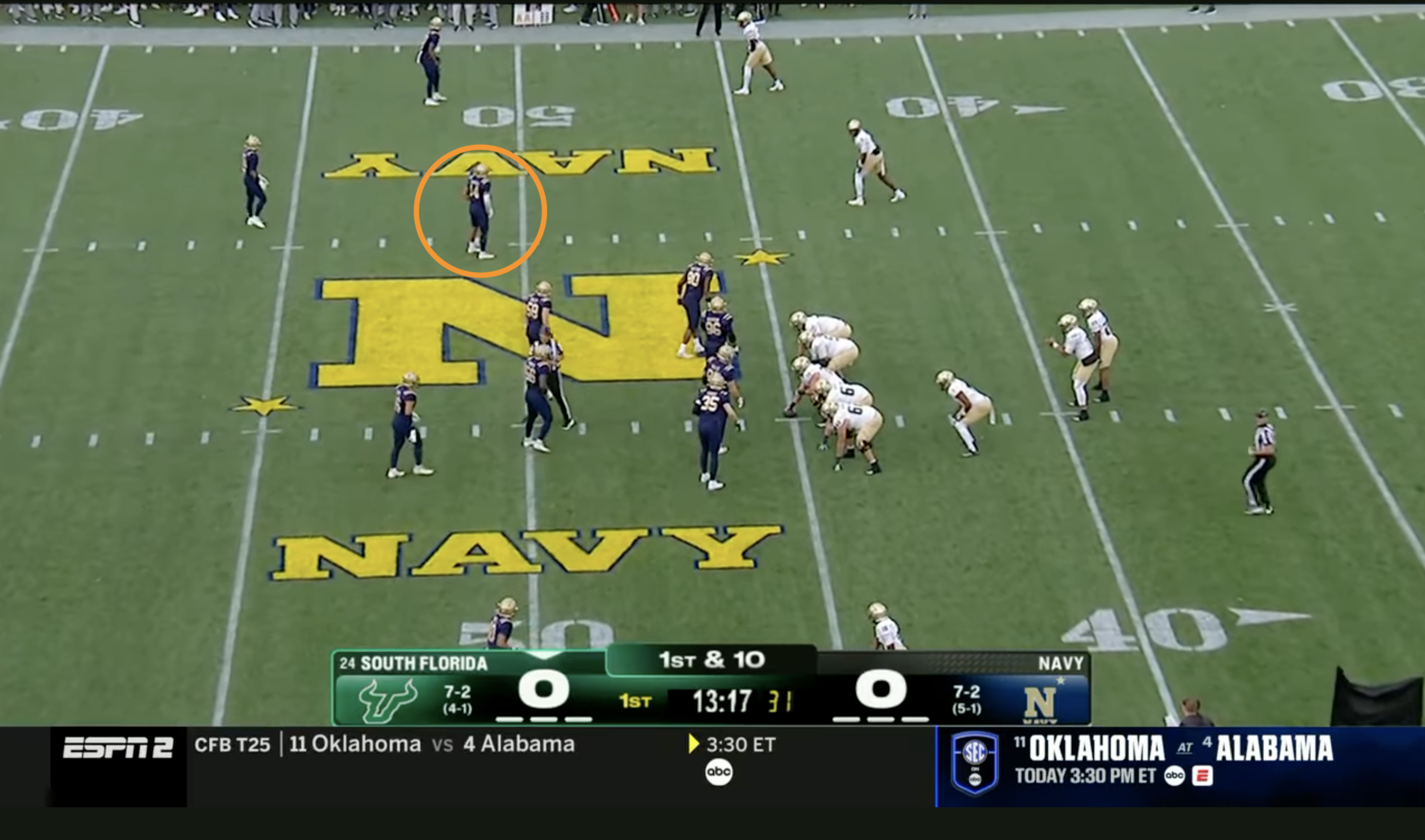
Both referees are still in their backpedal to get out of the play - a great indicator of pace.
7-8 defensive guys don't have "cleats in the ground" as Golesh calls it - meaning, they aren't lined up and ready to play. The entire d-Line isn't even in their stance.
Multiple defensive backs are looking the sideline to get the call.
The nickel, who I have circled, is late fitting the run because his eyes are on the sideline, and so this simple inside zone with a bubble pops for eight yards.
There are dozens of examples just like this from each game. These are exactly the types of looks Golesh wants to get when they go fast. South Florida and Florida Atlantic tied for the fastest average time between plays at 21.4 seconds in 2025. Auburn should expect to see the same.
...